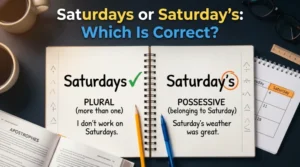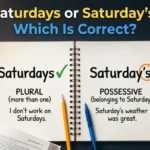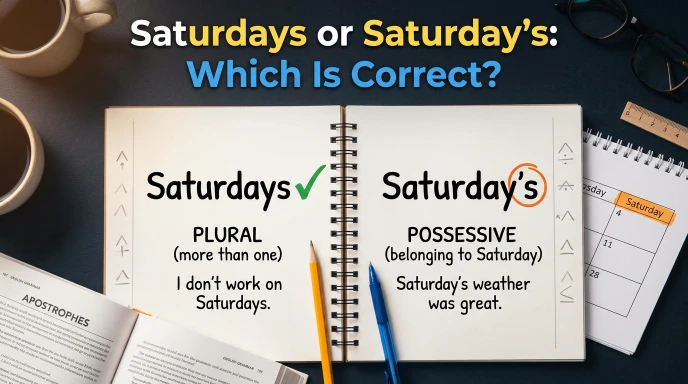
The correct form depends on your meaning: “Saturdays” means more than one Saturday, while “Saturday’s” shows possession or a missing word. Both forms are correct, but they serve different purposes.
Many people search for Saturdays or Saturday’s because the apostrophe can cause confusion. Should you write “I work on Saturdays” or “I work on Saturday’s”? The answer depends on the sentence. A small punctuation mark can change the meaning of your words.
You do not need to guess. You only need to understand when to use a plural noun and when to show possession. This guide explains the difference in simple English. You will learn the meaning, origin, spelling rules, common mistakes, and everyday uses of both forms.
You will also see clear examples that help you choose the right form in emails, messages, schoolwork, and formal writing. By the end, you will know when to write “Saturdays” and when “Saturday’s” makes sense.
Quick Answer
Use Saturdays when you mean more than one Saturday. Use Saturday’s to show that something belongs to Saturday or to shorten certain phrases.
Examples:
- Saturdays: I visit my grandparents on Saturdays.
- Saturday’s: Saturday’s weather looks sunny.
- Saturday’s: Saturday’s almost here! (Short for “Saturday is almost here.”)
Remember this simple rule: Use “Saturdays” for the plural and “Saturday’s” for possession or contraction.
The Origin of Saturdays or Saturday’s
The word Saturday comes from Old English Sæternesdæg, which means “Saturn’s day.” The name links the day to Saturn, the Roman god of agriculture and time.
Over time, English speakers shortened and changed the old form into the modern word “Saturday.”
The word Saturdays adds an s to show more than one Saturday. For example, “I work on Saturdays” means you work on several Saturdays.
The form Saturday’s adds an apostrophe before the final s. Writers use this form to show possession, as in “Saturday’s schedule.” They can also use it as a contraction, as in “Saturday’s a busy day,” which means “Saturday is a busy day.”
The difference comes from grammar, not from British or American spelling rules.
British English vs American English Spelling
British and American English use the same forms: Saturdays and Saturday’s. Neither variety changes the spelling rule.
Both forms follow the same basic grammar rules.
| Meaning | American English | British English |
| More than one Saturday | Saturdays | Saturdays |
| Something belongs to Saturday | Saturday’s | Saturday’s |
| Saturday is | Saturday’s | Saturday’s |
| More than one Saturday owns something | Saturdays’ | Saturdays’ |
Examples:
- American English: I go shopping on Saturdays.
- British English: I go shopping on Saturdays.
- Both varieties: Saturday’s meeting starts at noon.
The word Saturdays never needs an apostrophe to form its plural. The apostrophe in Saturday’s shows possession or replaces missing letters in a contraction.
Which Spelling Should You Use?
Choose the form that matches your meaning. Your audience does not change the basic rule.
Use Saturdays when you talk about repeated events or more than one Saturday.
Example: “Our shop opens on Saturdays.”
Use Saturday’s when you describe something that belongs to Saturday.
Example: “Saturday’s event starts at 10 a.m.”
You can also use Saturday’s as a contraction in informal writing.
Example: “Saturday’s going to be fun.”
For formal writing, avoid contractions when your style guide requires a more formal tone. You can write “Saturday is going to be fun” instead.
These rules work in the United States, the United Kingdom, Canada, Australia, and other English speaking regions.
Common Mistakes with Saturdays or Saturday’s
Writers often add an apostrophe when they only need a plural. Other writers forget the apostrophe when they want to show possession.
Using Saturday’s for the Plural
Incorrect: I work on Saturday’s.
Correct: I work on Saturdays.
Use Saturdays because the sentence refers to more than one Saturday.
Leaving Out the Apostrophe for Possession
Incorrect: Saturdays schedule looks busy.
Correct: Saturday’s schedule looks busy.
Use Saturday’s because the schedule belongs to Saturday.
Confusing a Plural with a Contraction
Incorrect: Saturdays going to be great!
Correct: Saturday’s going to be great!
Here, “Saturday’s” means “Saturday is.”
Using the Wrong Apostrophe Placement
Incorrect: Saturday s meeting starts at nine.
Correct: Saturday’s meeting starts at nine.
Place the apostrophe before the s when one Saturday owns or relates to something.
Saturdays or Saturday’s in Everyday Examples
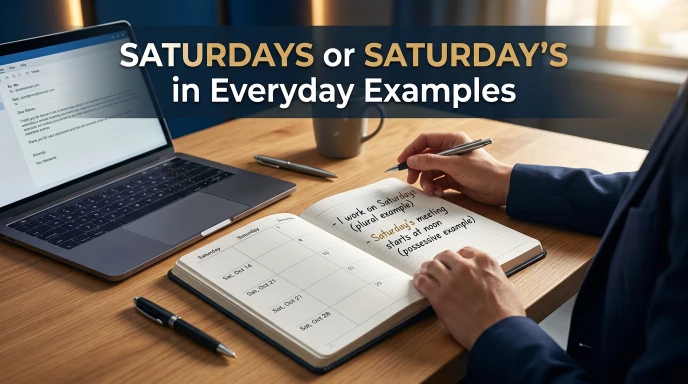
Both forms appear in everyday writing. The sentence tells you which form you need.
In Emails
- “I am available on Saturdays.”
- “Saturday’s meeting has moved to 11 a.m.”
In News
- “The store will open on Saturdays during the summer.”
- “Saturday’s storm caused travel delays.”
On Social Media
- “I love quiet Saturdays!”
- “Saturday’s almost here. Time to relax!”
In Formal Writing
- “The library opens on Saturdays.”
- “Saturday’s schedule includes three public events.”
In Everyday Conversation
- “We play football on Saturdays.”
- “Saturday’s my favorite day of the week.”
The first sentence in each pair uses the plural. The second uses possession or a contraction.
Saturdays or Saturday’s:Google Trends & Usage Data
People may search for Saturdays or Saturday’s when they want to check apostrophe rules or improve their writing. Both forms appear in everyday English, but they serve different grammar purposes.
The plural Saturdays often appears in sentences about habits, work schedules, shopping, and weekly events. For example, “I exercise on Saturdays.”
The possessive Saturday’s often appears in schedules, news reports, event notices, and descriptions. For example, “Saturday’s concert starts at 7 p.m.”
Search interest can change by country and over time. Without checking live Google Trends data, we cannot claim that one form receives more searches than the other.
For writing, explain the difference clearly and use natural examples. Readers want to know which form fits their sentence, not just which form appears more often.
Saturdays vs Saturday’s: Comparison Table
| Feature | Saturdays | Saturday’s |
| Main use | Plural | Possession or contraction |
| Apostrophe | No | Yes |
| Refers to multiple Saturdays | Yes | No |
| Shows possession | No | Yes |
| Can mean “Saturday is” | No | Yes |
| Example | I work on Saturdays. | Saturday’s meeting starts soon. |
| Correct for a weekly habit | Yes | No |
| Correct for a schedule belonging to Saturday | No | Yes |
The easiest way to remember the difference is to ask what your sentence means. If you mean several Saturdays, use Saturdays. If you mean something belongs to Saturday or “Saturday is,” use Saturday’s.
FAQs About Saturdays or Saturday’s
Q1. Is Saturdays or Saturday’s correct?
Both forms are correct. Use “Saturdays” for the plural and “Saturday’s” for possession or a contraction.
Q2. Should I write “on Saturdays” or “on Saturday’s”?
Write “on Saturdays.” The sentence refers to a repeated activity or more than one Saturday.
Q3. Does Saturday’s always show possession?
No. It can also shorten “Saturday is” or, in some contexts, “Saturday has.” For example, “Saturday’s here” means “Saturday is here.”
Q4. Is Saturday’s meeting correct?
Yes. The apostrophe shows that the meeting relates to Saturday.
Q5. Do British and American English use different forms?
No. Both varieties use “Saturdays” for the plural and “Saturday’s” for possession or a contraction.
Q6. Is “I love Saturday’s” correct?
Usually, no. If you mean that you love Saturdays in general, write “I love Saturdays.” Use “Saturday’s” only if the sentence needs possession or a contraction.
Q7. How can I remember the difference?
Remember this simple tip: No apostrophe for the plural; an apostrophe for possession or a contraction.
Conclusion
The difference between Saturdays or Saturday’s is simple once you understand the grammar rule. Use Saturdays when you talk about more than one Saturday or describe something you do every week. For example, “I visit my family on Saturdays.”
Use Saturday’s when something belongs to Saturday, as in “Saturday’s schedule.” You can also use it as a contraction for “Saturday is,” as in “Saturday’s almost here.”
British and American English follow the same rules, so you do not need to learn two different spellings. Just look at the meaning of your sentence before you choose.
Remember, an apostrophe does not make a noun plural. It shows possession or marks missing letters in a contraction. This small rule can help you avoid common writing mistakes in emails, schoolwork, social media posts, and formal documents.
When you feel unsure, read your sentence aloud and ask yourself what you mean. If you mean several Saturdays, choose Saturdays. If you mean possession or a contraction, choose Saturday’s.
Discover More About!
Bite or Bit: Which Word Is Correct?
CZ or Moissanite: Which One Should You Choose?
Unity or Godot: Which Game Engine Should You Use?