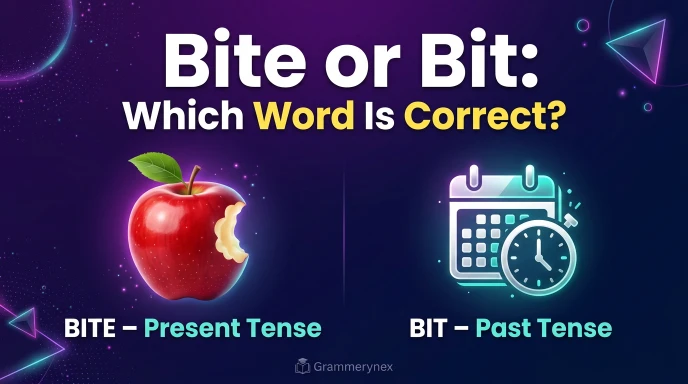
Bite or bit? Both words are correct, but “bite” is the base form of the verb, while “bit” is its simple past tense. For example, you can say, “Dogs bite when they feel scared,” or “The dog bit me yesterday.”
Many people search for “bite or bit” because these words look alike and share the same meaning in some sentences. However, the correct choice depends on the time of the action and the way you use the word. If you talk about a habit, use bite. If you talk about an action that happened in the past, use bit.
The word bit also has other meanings. It can mean a small amount, a short piece, or a unit of digital data. These meanings can confuse English learners who want to write clear sentences.
The good news is that you can learn the difference with a simple rule. This guide explains the meaning, origin, grammar, and common uses of both words. You will also find clear examples, common mistakes, and tips to help you choose the right word in everyday writing.
Quick Answer
Bite is the base form of the verb. Bit is the simple past form of bite.
Examples:
- Bite: Dogs bite when they feel scared.
- Bit: The dog bit my shoe yesterday.
- Bitten: The dog has bitten my shoe before.
- A bit: I need a bit of help.
Remember this simple pattern:
Bite → Bit → Bitten
Use bite for the base verb, bit for a past action, and bitten as the standard past participle. Use a bit when you mean a small amount.
Definition and Meaning of Bite or Bit
What Does Bite Mean?
The word bite can work as a verb or a noun.
As a verb, it means to cut, grip, or break something with the teeth.
Examples:
- I bite my nails when I feel nervous.
- The puppy likes to bite its toy.
- Mosquitoes bite people in warm weather.
As a noun, bite means an act of biting or a piece of food taken with the teeth.
Examples:
- She took a bite of the apple.
- He ate one bite of cake.
The word can also describe a strong effect. For example, “Higher prices began to bite” means that higher prices started to cause problems.
What Does Bit Mean?
Bit has several meanings. It is the simple past tense of bite. It can also mean a small amount or piece.
Examples:
- The dog bit my shoe.
- I bit into a fresh apple.
- Please wait a bit.
- I need a bit of time.
In computing, a bit is a basic unit of digital information. It can hold a value of 0 or 1.
What Is the Difference Between Bite, Bit, and Bitten?
These three forms have different grammar roles.
| Word | Meaning or use | Example |
| Bite | Base verb | I bite my nails. |
| Bit | Simple past | I bit my nails yesterday. |
| Bitten | Past participle | I have bitten my nails before. |
| Biting | Present participle | The puppy is biting its toy. |
Learning these forms will help you use the verb correctly in both speech and writing.
The Origin of Bite or Bit
The word bite comes from Old English bītan. It has Germanic roots and has described the action of using teeth for many centuries.
The word bit developed as the past form of bite. English has many irregular verbs that change their spelling instead of adding ed to show the past.
Here are some examples:
- Bite becomes bit.
- Write becomes wrote.
- Drive becomes drove.
- Speak becomes spoke.
These changes may seem unusual, but they follow patterns found in older forms of English.
The word bit also gained other meanings over time. People use it to describe a small amount or piece. In computing, bit comes from the phrase “binary digit.”
So, bite and bit share a history as verb forms, but bit also has meanings that do not relate to biting.
British English vs American English Spelling
British and American English use bite and bit in the same way. Neither variety has a different spelling rule for these words.
Both use bite as the base verb and bit as the simple past. Both also use bitten as the standard past participle.
| Grammar use | British English | American English |
| Base verb | I bite my nails. | I bite my nails. |
| Simple past | I bit my nails. | I bit my nails. |
| Past participle | I have bitten my nails. | I have bitten my nails. |
| Small amount | Wait a bit. | Wait a bit. |
| Food | Take a bite of the apple. | Take a bite of the apple. |
Examples:
- British English: “The dog bit my hand yesterday.”
- American English: “The dog bit my hand yesterday.”
- Both: “The dog has bitten my shoe.”
For clear and correct writing, use bit for the simple past and bitten after have, has, or had.
Which Spelling Should You Use?
Your sentence decides if you need bite or bit. Your audience does not change the main rule.
For US English
Use bite for the base verb and bit for a past action.
- Present: “I bite my nails.”
- Past: “I bit my nails yesterday.”
- Past participle: “I have bitten my nails before.”
For UK English
Follow the same rule.
- Present: “The dog may bite.”
- Past: “The dog bit my shoe.”
- Past participle: “The dog has bitten my shoe.”
For Global English
Use these simple rules in schoolwork, emails, blogs, and professional writing:
- Use bite for the base verb.
- Use bit for the simple past.
- Use bitten as the standard past participle.
- Use a bit when you mean a small amount.
These forms work well for readers around the world.
Common Mistakes with Bite or Bit
English learners often mix up these words because they share the same root. Here are common errors and their corrections.
Using Bit for a Present Action
Incorrect: I bit my nails every day.
Correct: I bite my nails every day.
Use bite to describe a habit or a general action in the present.
Using Bite for a Past Action
Incorrect: The dog bite me yesterday.
Correct: The dog bit me yesterday.
Use bit when an action happened in the past.
Using Bit After Did
Incorrect: Did the dog bit you?
Correct: Did the dog bite you?
The word did already shows the past tense. Use the base form bite after it.
Using Bitten as the Simple Past
Incorrect: The dog bitten my shoe yesterday.
Correct: The dog bit my shoe yesterday.
Use bit for a simple past action.
Writing Bited
Incorrect: The cat bited my finger.
Correct: The cat bit my finger.
Bited is not the standard past form of bite. Remember the correct pattern: bite, bit, bitten.
Confusing the Noun and Verb
Compare these sentences:
- “I bit the apple.” Here, bit is a verb.
- “I ate a bit of apple.” Here, bit is a noun that means a small piece.
Bite or Bit in Everyday Examples

These examples show how people use bite and bit in daily life.
In Emails
Bite: “Please remind the children not to bite their pencils.”
Bit: “My dog bit my shoe while I worked from home yesterday.”
In News
Bite: “The report warns that rising costs may bite into family budgets.”
Bit: “The dog bit a man at the park on Monday.”
On Social Media
Bite: “Try not to bite your nails when you feel stressed!”
Bit: “My puppy bit my favorite slipper again!”
In Formal Writing
Bite: “Some insects bite people to feed on blood.”
Bit: “The insect bit the researcher during the study.”
In Everyday Speech
- “Do not bite your nails.”
- “The mosquito bit me last night.”
- “Please wait a bit.”
- “Can I have a bite of your sandwich?”
These examples show how the sentence helps you choose the right word.
Bite or Bit:Google Trends & Usage Data
People search for bite or bit when they need help with verb forms, spelling, and sentence grammar. However, both words also appear in other topics, so search interest does not always reflect grammar questions.
What Affects Search Interest?
- Grammar lessons: Students look for the past tense of bite.
- Animal bites: People search for information about dog bites and insect bites.
- Food and cooking: People use bite to describe eating and small pieces of food.
- Technology: People search for bit when they learn about computer data.
- Everyday English: Learners look for examples that explain the difference between the words.
Which Countries Search for These Words?
People in the United States, United Kingdom, Canada, Australia, India, and other English speaking or English learning markets may search for these terms.
However, the countries do not have a fixed ranking for searches about bite or bit. Search results depend on the selected time range, location, search type, and exact query.
Google Trends shows relative search interest rather than exact search counts. It can help you compare terms and locations, but it does not always show every spelling or phrase in the same way.
You can explore current results through.
For this topic, the most useful point is the difference in grammar. Readers want to know when to use bite, when to use bit, and how to form bitten. Clear examples can help them understand the rule and avoid common errors.
Bite vs Bit: Comparison Table
| Feature | Bite | Bit |
| Main verb use | Base form | Simple past form |
| Present example | I bite the apple. | Not standard for this verb use |
| Past example | Not the simple past form | I bit the apple. |
| Noun meaning | An act or piece taken with the teeth | A small amount or piece |
| Computing meaning | No common related meaning | A unit of digital information |
| Example with did | Did you bite me? | “Did you bit me?” is incorrect |
| Past participle | Use bitten | Bitten is the standard form |
| British vs American spelling | Same spelling | Same spelling |
FAQs About Bite or Bit
Q1. Is it bite or bit?
Both words are correct, but they have different uses. Bite is the base form of the verb, while bit is its simple past tense.
Q2. What is the past tense of bite?
The simple past tense of bite is bit.
Example: “The dog bit my shoe.”
Q3. Is bitten also correct?
Yes. Bitten is the standard past participle of bite.
Example: “The dog has bitten my shoe before.”
Q4. Is it “Did you bite me” or “Did you bit me”?
“Did you bite me?” is correct. After did, use the base form of the verb.
Q5. Can bit mean a small amount?
Yes. Bit can mean a small amount or piece.
Example: “I need a bit of time.”
Q6. Do British and American English use bite and bit differently?
No major spelling difference exists. Both varieties use bite as the base form and bit as the simple past. Bitten is the standard past participle.
Q7. Is “bited” a correct word?
No. Bited is not the standard past form of bite. Use bit instead.
Conclusion
The difference between bite or bit becomes easy when you learn their roles. Bite is the base form of the verb. Use it for present actions, general facts, and sentences with words such as will, can, and did. For example, “Dogs bite when they feel scared” and “Did the dog bite you?” both use the correct form.
Use bit when you describe an action that happened in the past. For example, “The dog bit my shoe yesterday.” Remember that bit can also work as a noun. In phrases such as “a bit of help,” it means a small amount. In computing, it means a unit of digital information.
When you need the past participle, choose bitten in standard writing. For example, “The dog has bitten my shoe before.” This rule works in both British and American English.
The best way to remember the difference is to learn the pattern bite, bit, bitten and practice it in short sentences. Once you know this pattern, you can use both words with confidence in schoolwork, emails, social media posts, and professional writing.
Discover More About!
CZ or Moissanite: Which One Should You Choose?
Unity or Godot: Which Game Engine Should You Use?
TurboTax or TaxAct: Which Tax Software Should You Use?

I’m Riley Morgan, a writer at Grammerynex, where I write about English grammar, spelling, word meanings, and everyday language usage. I’ve always enjoyed exploring how words work and why some English terms can be confusing. My goal is to explain grammar and word differences in a simple, clear, and practical way so readers can understand English better and use it with confidence.




1 thought on “Bite or Bit: Which Word Is Correct?”