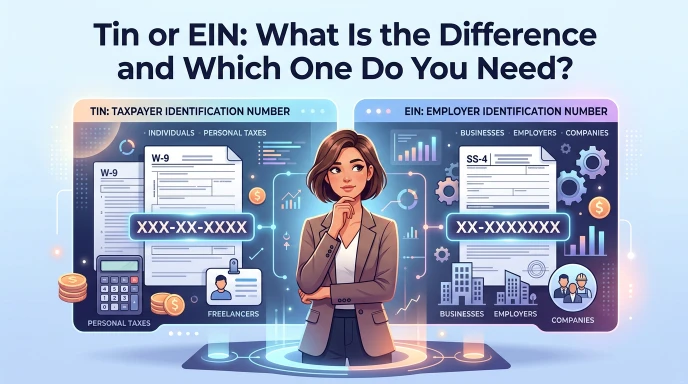
TIN and EIN are both US tax identification numbers, but an EIN is a specific type of TIN used mainly to identify businesses and other entities. Many people search for “tin or ein” because tax forms, banks, employers, and government agencies may ask for one of these numbers. The terms can look similar, but they do not mean exactly the same thing.
A TIN, or Taxpayer Identification Number, is a broad term. It covers several types of identification numbers that the IRS uses for tax purposes. An EIN, or Employer Identification Number, is one specific type of TIN.
This difference matters when you complete a tax form, open a business bank account, hire workers, or report income. Using the wrong number can cause delays or errors.
The good news is that the basic rule is easy to remember: every EIN is a TIN, but not every TIN is an EIN. This guide explains the meaning, origin, usage, differences, common mistakes, and practical examples of tin or ein in simple terms.
Quick Answer
TIN means Taxpayer Identification Number. It is a general term for numbers that identify taxpayers for US tax purposes.
EIN means Employer Identification Number. It identifies businesses, organizations, estates, trusts, and certain other entities for federal tax purposes.
In simple terms:
- TIN = a broad tax identification category
- EIN = one type of TIN
- SSN = another type of TIN
- ITIN = another type of TIN
For example, a person may use an SSN as their TIN. A business may use an EIN as its TIN.
So, if a form asks for your TIN, an EIN may be correct if you are completing the form for a business that uses an EIN.
Definition and Meaning of Tin or EIN
What Is a TIN?
TIN stands for Taxpayer Identification Number.
The IRS uses the term TIN for different numbers that identify people and entities for federal tax purposes.
Common types include:
- Social Security Number (SSN)
- Employer Identification Number (EIN)
- Individual Taxpayer Identification Number (ITIN)
- Adoption Taxpayer Identification Number (ATIN)
- Preparer Taxpayer Identification Number (PTIN)
The exact number you need depends on your situation and the type of tax activity involved.
What Is an EIN?
EIN stands for Employer Identification Number.
The IRS assigns an EIN to identify a business or other entity for federal tax purposes. Despite the word Employer in the name, you do not need to have employees to use an EIN.
Businesses may need an EIN when they:
- Start a business
- Hire employees
- Operate as certain types of corporations or partnerships
- Open a business bank account
- File certain business tax returns
- Handle specific tax matters
Is an EIN a TIN?
Yes.
An EIN is a type of TIN.
Think of the relationship like this:
TIN → EIN
The word TIN describes the larger category. EIN describes one specific number within that category.
Different Meanings and Uses
The term TIN can refer to different identification numbers depending on the taxpayer.
For example:
| Number | Full Name | Common User |
| SSN | Social Security Number | Individuals |
| EIN | Employer Identification Number | Businesses and organizations |
| ITIN | Individual Taxpayer Identification Number | Certain individuals who cannot get an SSN |
| ATIN | Adoption Taxpayer Identification Number | Certain adoption cases |
| PTIN | Preparer Taxpayer Identification Number | Paid tax preparers |
This explains why TIN or EIN can cause confusion. An EIN is not a separate alternative to every TIN. It sits inside the larger TIN category.
The Origin of Tin or EIN
The terms TIN and EIN come from the US federal tax system.
The IRS uses identification numbers to identify taxpayers and process tax information. As tax rules became more complex, different types of taxpayers needed different identification numbers.
The term Taxpayer Identification Number describes the broader category.
The Employer Identification Number serves a more specific purpose. The IRS uses it to identify business entities and other organizations for federal tax matters.
The two abbreviations also use different words:
- TIN = Taxpayer Identification Number
- EIN = Employer Identification Number
The word taxpayer makes TIN broader. The word employer makes EIN more specific.
However, the name EIN can cause a common misunderstanding. A business does not need employees simply because it has an EIN. The IRS can require an EIN for many entities and tax situations that do not involve employees.
British English vs American English Spelling
TIN and EIN are US tax terms, not British or American spelling variations.
The United States uses these abbreviations in its federal tax system. Other countries use different tax identification systems and names.
For US tax writing, use the standard capitalized forms:
- TIN
- EIN
- SSN
- ITIN
Do not write them as ordinary lowercase words such as “tin” or “ein” when you mean the tax terms.
| Term | Correct Form | Meaning | US Tax Use |
| TIN | TIN | Taxpayer Identification Number | General tax identification |
| EIN | EIN | Employer Identification Number | Business and entity identification |
| SSN | SSN | Social Security Number | Individual identification |
| ITIN | ITIN | Individual Taxpayer Identification Number | Certain individuals |
| ATIN | ATIN | Adoption Taxpayer Identification Number | Certain adoption cases |
| PTIN | PTIN | Preparer Taxpayer Identification Number | Paid tax preparers |
The terms may appear in international tax discussions, but their meanings depend on the country.
Which Spelling Should You Use?
Use TIN when you need the general term Taxpayer Identification Number.
Use EIN when you specifically mean an Employer Identification Number.
For US Individuals
An individual may use an SSN as their TIN when the IRS or another organization asks for a taxpayer identification number.
Some individuals who cannot get an SSN may use an ITIN when they meet the IRS requirements.
For US Businesses
A business may use an EIN for federal tax identification.
For example:
Our company uses its EIN for federal tax reporting.
For UK and Commonwealth Readers
If you write for readers outside the United States, explain the US terms the first time you use them.
For example:
An EIN, or Employer Identification Number, identifies a US business for federal tax purposes.
This approach helps readers who may use a different tax identification system in their own country.
For a Global Audience
Use the full term before the abbreviation:
Taxpayer Identification Number (TIN)
and:
Employer Identification Number (EIN)
After that, you can use the shorter forms.
Common Mistakes with Tin or EIN
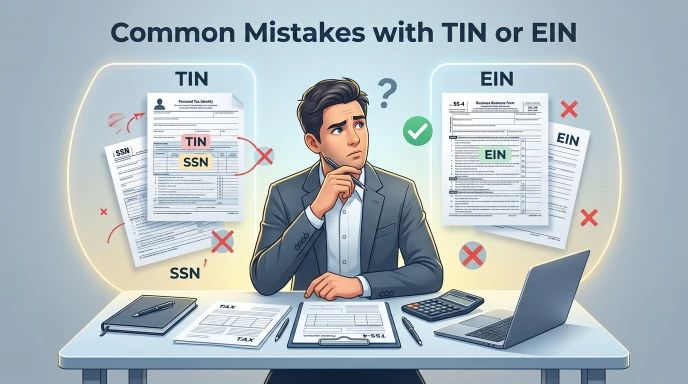
Thinking TIN and EIN Mean the Same Thing
They do not.
TIN is the broad category. EIN is one type of TIN.
Assuming Every TIN Is an EIN
This is incorrect.
A person’s TIN may be an SSN or ITIN, depending on their situation.
Thinking EIN Means You Have Employees
The name can cause confusion.
An EIN can apply to businesses and other entities even when they do not have employees.
Using a Personal SSN Instead of a Business EIN
A business may need its own EIN for certain tax and financial activities.
Do not assume that your personal SSN can replace an EIN.
Writing TIN as “Tax ID” Without Checking the Form
People often use Tax ID as a general phrase. However, a form may require a specific number.
Always read the instructions before entering an SSN, ITIN, or EIN.
Mixing Up EIN and ITIN
These numbers serve different purposes.
- EIN = mainly identifies businesses and other entities
- ITIN = identifies certain individuals for federal tax purposes
Tin or EIN in Everyday Examples
These terms appear often in tax forms, business documents, banking, and professional communication.
In Emails
Please provide your EIN so we can complete the business tax paperwork.
Another example:
The form asks for a TIN. Please check which taxpayer identification number applies to you.
In News
The company applied for an EIN after forming its new business entity.
News articles may use both TIN and EIN when discussing taxes, businesses, or government records.
On Social Media
A business owner might write:
I just received my EIN. Now I can move on to the next step in setting up my business.
This informal use is common among new business owners.
In Formal Writing
The organization must provide its Employer Identification Number (EIN) when required for federal tax reporting.
Formal writing should explain abbreviations when readers may not know them.
On Tax Forms
A form may ask for a TIN and provide instructions about which number you should enter.
The correct answer can depend on if the form concerns an individual, business, trust, estate, or another taxpayer.
Tin or EIN:Google Trends & Usage Data
Search interest for tin or ein usually comes from people who need to complete a tax form or understand a business requirement.
Searches can increase around:
- Tax filing deadlines
- Business formation
- Employment paperwork
- Banking requirements
- Contractor forms
- Government forms
- Business registration
The term EIN often appears in searches related to starting a business. People may search phrases such as:
- How to get an EIN
- What is an EIN?
- EIN number
- Do I need an EIN?
- EIN vs TIN
The term TIN often appears in tax and financial contexts. Searches can include:
- What is a TIN?
- TIN number
- TIN vs EIN
- Where can I find my TIN?
- What is my taxpayer identification number?
Search patterns can vary by country. Since EIN is a US federal tax term, searches for EIN often come from people dealing with US businesses or US tax matters.
Google Trends can show changes in search interest over time, but search interest does not decide the legal meaning of these terms. For tax questions, always rely on current IRS instructions and the instructions on the specific form.
Tin or EIN Comparison Table
| Feature | TIN | EIN |
| Full name | Taxpayer Identification Number | Employer Identification Number |
| Type | General category | Specific type of TIN |
| Main purpose | Identifies taxpayers | Identifies businesses and certain entities |
| Can identify individuals? | Yes | Usually no |
| Can identify businesses? | Yes | Yes |
| Includes SSN? | Yes | No |
| Includes ITIN? | Yes | No |
| Includes EIN? | Yes | Yes |
| US tax term? | Yes | Yes |
| Best use | General tax identification | Business or entity tax identification |
TIN vs EIN: Simple Rule to Remember
The easiest rule is:
EIN is a TIN, but TIN does not always mean EIN.
Think of TIN as the main category.
Under that category, you can find several types of taxpayer identification numbers.
For example:
TIN
- SSN
- EIN
- ITIN
- ATIN
- Other applicable taxpayer identification numbers
This simple structure can help you choose the right term when filling out forms or writing about US taxes.
FAQs
Q1:Is an EIN the same as a TIN?
No. An EIN is one type of TIN. TIN is the broader term for taxpayer identification numbers.
Q2:Can an EIN be used as a TIN?
Yes. An EIN qualifies as a taxpayer identification number for federal tax purposes.
Q3:What does TIN stand for?
TIN stands for Taxpayer Identification Number.
Q4:What does EIN stand for?
EIN stands for Employer Identification Number.
Q5:Is an SSN a TIN?
Yes. An SSN can serve as a taxpayer identification number for an individual.
Q6:Is an ITIN a TIN?
Yes. An ITIN is a type of taxpayer identification number for certain individuals who need a US tax number but cannot get an SSN.
Q7:Does every business need an EIN?
Not every business needs an EIN in every situation. The requirement depends on the business structure and tax circumstances. Check the current IRS rules for your specific case.
Q8:Where can I find my EIN?
If the IRS issued an EIN to your business, you may find it on documents from the IRS or on business tax records that use the number. If you cannot locate it, use the IRS’s current guidance for recovering an EIN.
Conclusion
The difference between tin or ein becomes simple once you understand the relationship between the two terms. TIN means Taxpayer Identification Number, while EIN means Employer Identification Number. A TIN is a broad category, and an EIN is one type within that category.
Individuals may use an SSN or ITIN as their taxpayer identification number, depending on their situation. Businesses and other qualifying entities may use an EIN for federal tax purposes.
The best term depends on what you mean. Use TIN when you are talking about taxpayer identification numbers in general. Use EIN when you specifically mean the number that identifies a business or other qualifying entity.
Remember the easiest rule: every EIN is a TIN, but not every TIN is an EIN. If a tax form asks for a TIN, read its instructions carefully before entering a number. If you need an EIN, check the latest IRS requirements. This simple step can help you avoid mistakes and keep your tax records accurate.
Explore More About!
Bend or Rentals: What Does “Bend OR Rentals” Mean?
Incurable or Uncurable: Which Word Is Correct?
Whining or Wining: Which Word Is Correct?

I’m Riley Morgan, a writer at Grammerynex, where I write about English grammar, spelling, word meanings, and everyday language usage. I’ve always enjoyed exploring how words work and why some English terms can be confusing. My goal is to explain grammar and word differences in a simple, clear, and practical way so readers can understand English better and use it with confidence.






3 thoughts on “Tin or EIN: What Is the Difference and Which One Do You Need?”