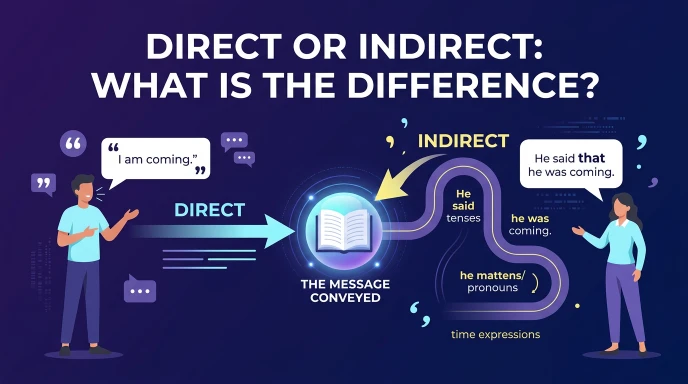
Direct means clear, straight, or without another step, while indirect means not direct or reaching a result through another person, thing, or step.
People often search for direct or indirect because these words look simple but can have different meanings in different situations. You may see them in English grammar, communication, speech, business, travel, science, and everyday life. The basic idea stays the same, but the exact use can change with the context.
For example, a direct answer gives information clearly. An indirect answer may suggest the meaning without saying it clearly. A direct flight goes from one place to another without a connecting flight. An indirect flight uses one or more stops.
These words also appear in grammar. Direct speech repeats a person’s exact words. Indirect speech reports the meaning without using the exact words.
In this guide, you will learn the meaning, origin, spelling, common mistakes, and everyday use of direct or indirect. You will also see simple examples that make the difference easy to understand.
Quick Answer
- Direct means clear, straight, or without an extra step. Indirect means not straight, not clear, or involving another step.
- Direct Examples
- She gave me a direct answer.
- We took a direct flight.
- He spoke to me directly.
- The road leads directly to the station.
- Indirect Examples
- She gave an indirect answer.
- We took an indirect route.
- He sent the message through a friend.
- The comment was an indirect way to ask for help.
- Easy Rule
- Think of direct as straight and clear.
- Think of indirect as through another way or less clear.
The Origin of Direct or Indirect
The words direct and indirect have a long history in English.
Origin of Direct
Direct comes from the Latin word directus. It relates to the idea of making something straight or guiding it in a straight line.
English later adopted the word direct. Today, it can describe a straight path, clear communication, or an action that does not use an extra step.
For example:
- direct route
- direct answer
- direct contact
- direct speech
Origin of Indirect
Indirect combines in , meaning “not,” with direct.
So, indirect carries the basic idea of not direct.
It can describe something that takes another route, uses another person, or does not express an idea in a clear way.
For example:
- indirect route
- indirect question
- indirect speech
- indirect message
Why Do These Words Look Similar?
The words share the same base word, direct. The prefix in changes its meaning.
This pattern appears in many English words.
For example:
- direct → indirect
- complete → incomplete
- correct → incorrect
- visible → invisible
The spelling does not change between British and American English.
British English vs American English Spelling
Direct and indirect have the same spelling in British and American English.
There is no spelling change between the two forms of English.
| Meaning | British English | American English |
| Straight or clear | Direct | Direct |
| Not direct | Indirect | Indirect |
| In a straight way | Directly | Directly |
| Not in a direct way | Indirectly | Indirectly |
Examples
British English:
“She gave a direct answer.”
American English:
“She gave a direct answer.”
British English:
“He took an indirect route.”
American English:
“He took an indirect route.”
Both versions use the same spelling.
Which Spelling Should You Use?
You can use direct and indirect in both British and American English.
You do not need to change the spelling for your audience.
For American English
Use:
- direct
- indirect
- directly
- indirectly
For British English
Use the same spellings:
- direct
- indirect
- directly
- indirectly
For Global English
These words work well for a global audience. They are common and easy to understand.
The main point is not spelling. The main point is choosing the word that matches your meaning.
Use direct when something goes straight to the point.
Use indirect when something takes another path or gives an idea less clearly.
Common Mistakes With Direct or Indirect
Thinking Indirect Means Wrong
Indirect does not mean wrong.
An indirect method can still work well.
Example:
“An indirect route can save time during heavy traffic.”
The route is not wrong. It simply does not go straight to the destination.
Using Direct When You Mean Clear
The word direct can mean clear, but context matters.
Example:
“He gave a direct answer.”
This means he answered clearly and did not avoid the question.
Confusing Direct and Indirect Speech
Direct speech gives the speaker’s exact words.
Direct speech:
Sarah said, “I am tired.”
Indirect speech reports the meaning.
Indirect speech:
Sarah said that she was tired.
The two forms communicate the same basic idea, but they use different structures.
Confusing Direct and Indirect Questions
A direct question asks something clearly.
Direct question:
“Where do you live?”
An indirect question sounds more polite or less direct.
Indirect question:
“Could you tell me where you live?”
The second sentence does not use the same question structure as the first one.
Thinking Indirect Always Means Polite
An indirect statement can sound polite, but indirect language does not always show politeness.
For example:
“He indirectly blamed his coworker.”
Here, the speaker did not blame the coworker in a clear or open way.
Direct or Indirect in Everyday Examples
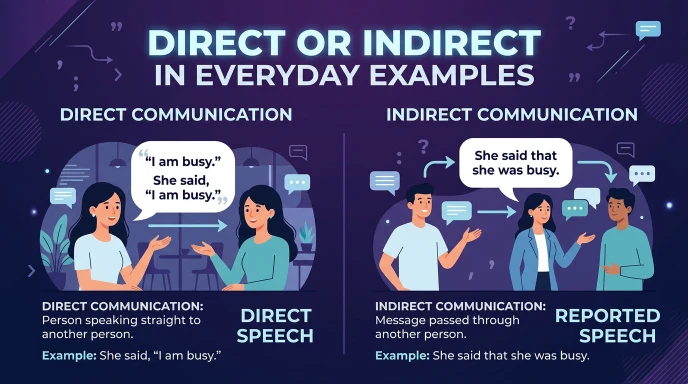
These words appear in many areas of daily life.
In Emails
A direct email can state the main point quickly.
Example:
“Please send the report by Friday.”
An indirect email may use softer language.
Example:
“It would be helpful if you could send the report by Friday.”
Both sentences ask for the report. The second one uses a softer approach.
In News
News reports may use both words.
Example:
“The company had direct contact with the customer.”
Another example:
“The decision had an indirect effect on local businesses.”
On Social Media
People often use direct and indirect to describe comments.
Example:
“That post was a direct response to the criticism.”
Example:
“She made an indirect comment about the issue.”
In Formal Writing
Both words work well in formal writing.
Example:
“The study found a direct link between the two factors.”
Example:
“The change had an indirect effect on the final result.”
In Travel
A direct flight takes you from the departure point to the destination without a connecting flight.
An indirect route includes another stop or follows a less direct path.
Example:
“We chose a direct flight because it was faster.”
Direct or Indirect:Google Trends & Usage Data
The search phrase direct or indirect appears in many different contexts. People may search it for grammar, communication, mathematics, science, business, travel, or general English.
The meaning depends on the topic.
For example, English learners may search for:
- direct and indirect speech
- direct and indirect questions
- direct and indirect objects
- direct and indirect meaning
Travelers may search for:
- direct or indirect flights
- direct or indirect routes
Students may search for:
- direct and indirect relationships
- direct and indirect measurements
- direct and indirect evidence
Search interest can also vary by country. English learning searches often appear in countries where students study English as a second language. Travel related searches can increase in countries with high international travel.
Because search trends change over time, the exact popularity of direct or indirect can vary by location and topic. The phrase has broad use because both words appear in many areas of English and everyday life.
Direct vs Indirect: Comparison Table
| Feature | Direct | Indirect |
| Basic meaning | Straight or clear | Not straight or not clear |
| Communication | Clear and open | Less direct or through another person |
| Route | Straight route | Route with another path or stop |
| Speech | Exact words | Reported meaning |
| Question | Clear question | More polite or less direct question |
| Effect | Immediate connection | Connection through another factor |
| Example | Direct answer | Indirect answer |
| Adverb | Directly | Indirectly |
| Spelling in US English | Direct | Indirect |
| Spelling in UK English | Direct | Indirect |
Direct and Indirect in English Grammar
Grammar gives these words several important uses.
Direct Speech
Direct speech uses the speaker’s exact words.
Example:
John said, “I need help.”
The words inside the quotation marks show exactly what John said.
Indirect Speech
Indirect speech reports what someone said.
Example:
John said that he needed help.
The writer gives the meaning without repeating John’s exact words.
Direct Object
A direct object receives the action of a verb.
Example:
“She opened the door.”
Here, door is the direct object.
Indirect Object
An indirect object tells us who receives something.
Example:
“She gave me a book.”
Here, me is the indirect object. Book is the direct object.
FAQs
Q1:What is the difference between direct and indirect?
Direct means straight, clear, or without an extra step. Indirect means not straight, less clear, or involving another step.
Q2:Is direct the opposite of indirect?
Yes. In many common uses, direct and indirect have opposite meanings.
For example:
- direct answer → indirect answer
- direct route → indirect route
- direct speech → indirect speech
Q3:What is direct speech?
Direct speech repeats a person’s exact words.
Example:
Tom said, “I am busy.”
Q4:What is indirect speech?
Indirect speech reports what someone said without repeating the exact words.
Example:
Tom said that he was busy.
Q5:Is an indirect question more polite?
An indirect question often sounds more polite or less forceful than a direct question.
Direct: “Where is the bank?”
Indirect: “Could you tell me where the bank is?”
Q6:What is a direct object?
A direct object receives the action of a verb.
Example:
“She read the book.”
The word book is the direct object.
Q7:What is an indirect object?
An indirect object usually tells us who receives something.
Example:
“He gave Sarah a gift.”
Sarah is the indirect object, while gift is the direct object.
Conclusion
The difference between direct or indirect is simple when you focus on the basic idea. Direct means straight, clear, or without an extra step. Indirect means not straight, less clear, or using another way.
These words have the same spelling in British and American English. You do not need to change direct or indirect for a different English audience. Instead, focus on the meaning and the context.
You can use direct for clear answers, straight routes, direct speech, and direct effects. You can use indirect for less direct communication, alternative routes, indirect speech, and effects that happen through another factor.
English grammar also uses these terms in important ways. Direct speech gives exact words, while indirect speech reports the meaning. Direct and indirect objects also play different roles in sentences.
Once you understand the basic difference, these words become easy to use. Remember one simple rule: direct goes straight, while indirect takes another way.
Discover More About!
- Dito or Ditto: Which Word Is Correct?
- Tazing or Tasing: Which Spelling Is Correct?
- Borrow or Barrow: Which Word Is Correct?

I’m Riley Morgan, a writer at Grammerynex, where I write about English grammar, spelling, word meanings, and everyday language usage. I’ve always enjoyed exploring how words work and why some English terms can be confusing. My goal is to explain grammar and word differences in a simple, clear, and practical way so readers can understand English better and use it with confidence.