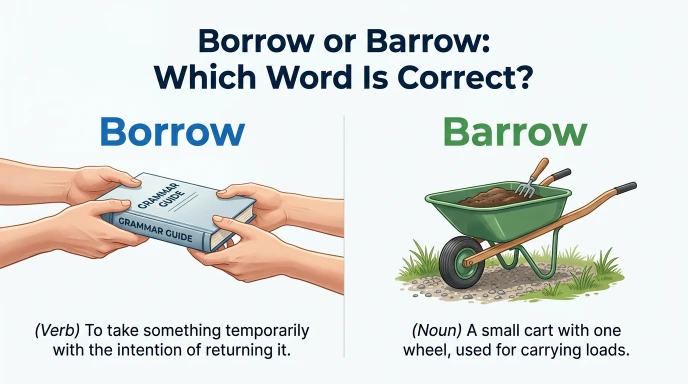
Have you ever typed “Can I barrow your pen?” and wondered if the spelling looks right? You are not alone. Borrow or barrow can confuse many English learners because both words look and sound very similar. However, they have different meanings and uses.
The good news is simple: borrow usually means taking something from someone for a short time and planning to return it. Barrow usually means a small cart, a wheelbarrow, or an ancient burial mound.
This small spelling difference can change the whole meaning of a sentence. For example, “Can I borrow your book?” asks for permission to use a book. “Can I barrow your book?” uses the wrong word for that meaning.
This guide explains borrow or barrow in simple English. You will learn their meanings, origins, spelling, common mistakes, and everyday uses. You will also see examples that can help you choose the right word quickly.
Quick Answer
- Borrow and barrow are both real English words. They do not mean the same thing.
- Borrow means to take or use something for a time and return it later.
- Barrow means a cart or carrier used to move things. It can also mean an ancient burial mound.
- Examples of Borrow
- Can I borrow your pen?
- I need to borrow some money.
- She borrowed my book.
- We borrowed chairs from our neighbors.
- Examples of Barrow
- He pushed a barrow across the garden.
- The worker filled the barrow with soil.
- Archaeologists found an ancient barrow.
- The farmer used a barrow to carry vegetables.
- Easy Trick to Remember
- Think of borrow when you take something for temporary use.
- Think of barrow when you move something with a cart.
- Borrow = use and return
- Barrow = carry or mound
The Origin of Borrow or Barrow
The words borrow and barrow have different histories. Their similar spelling does not make them different forms of the same word.
The Origin of Borrow
Borrow comes from Old English borgian. The word once connected with ideas such as pledging, guaranteeing, and obtaining something with a promise to return it. Over time, its meaning developed into the modern sense of taking something temporarily with an expectation of return.
Today, we use borrow for many things.
For example:
- borrow a book
- borrow money
- borrow a phone
- borrow an idea
- borrow a word from another language
The word also appears in other expressions. For example, people say borrowed time when someone or something has extra time before an expected end.
The Origin of Barrow
Barrow has more than one historical source. One meaning comes from Old English bearwe, which referred to a basket, stretcher, or carrier. This history connects with the verb bear, which means to carry.
Another meaning of barrow comes from Old English beorg, which referred to a hill or mound. This meaning later developed into the archaeological sense of a burial mound.
That explains why barrow can refer to both a cart and an ancient mound.
British English vs American English Spelling
Many readers ask if borrow and barrow represent British and American spelling.
They do not.
British English and American English both use borrow when someone takes something temporarily and plans to return it. Both varieties also use barrow for its specific meanings.
The difference comes from meaning, not from regional spelling.
| Word | British English | American English | Main Meaning |
| borrow | Yes | Yes | Take something temporarily |
| barrow | Yes | Yes | Cart, carrier, or burial mound |
| wheelbarrow | Yes | Yes | One wheel garden or work cart |
| barrow | Yes | Yes | Ancient burial mound |
Oxford lists barrow as a British English noun for a small vehicle, a burial mound, and a container with a wheel and handles.
So you should not choose borrow because you write American English or barrow because you write British English. Instead, choose the word that matches your meaning.
Which Spelling Should You Use?
Your audience does not change the basic choice between borrow and barrow.
For US English
Use borrow when you mean temporary use.
- Can I borrow your laptop?
- I borrowed some money from my brother.
Use barrow when you mean a cart or another established meaning.
- The worker pushed a barrow of soil.
For UK and Commonwealth English
Use borrow for temporary use.
- May I borrow your notes?
- She borrowed my umbrella.
Use barrow for a cart, wheelbarrow, or burial mound.
- He moved the stones with a barrow.
For Global English
If you write for an international audience, use the same rule.
Borrow means temporary use.
Barrow means a cart, carrier, burial mound, or another specific meaning.
This rule works well in emails, schoolwork, business writing, and online content.
Common Mistakes with Borrow or Barrow
Writers often confuse these words because they have similar letters and sounds.
Using Barrow for Temporary Use
Incorrect:
Can I barrow your phone?
Correct:
Can I borrow your phone?
The sentence needs borrow because the person wants to use the phone temporarily.
Using Borrow for a Cart
Incorrect:
He pushed a borrow through the garden.
Correct:
He pushed a barrow through the garden.
The sentence describes a cart, so barrow fits.
Confusing Borrow With Lend
This mistake also causes problems.
Borrow describes the person who receives something.
Lend describes the person who gives something.
For example:
Can I borrow your book?
Can you lend me your book?
The meaning stays connected, but the speaker changes the viewpoint.
Adding the Wrong Double R
Both words contain two r letters:
- borrow
- barrow
But they use different vowels.
Remember:
Borrow = b o r r o w
Barrow = b a r r o w
Borrow or Barrow in Everyday Examples
You may see both words in different types of writing.
In Emails
Use borrow when you ask someone to let you use something.
Hi Sarah, may I borrow your notes from yesterday’s meeting?
Another example:
Could I borrow your charger for a few minutes?
In News
News reports may use borrow when they discuss money, ideas, or resources.
The company plans to borrow money to expand its business.
News articles may use barrow when they discuss history, archaeology, farming, or transport.
Researchers discovered an ancient burial barrow near the village.
On Social Media
People often use borrow in casual messages.
Can I borrow your headphones?
Does anyone have a charger I can borrow?
The word barrow appears less often in casual social media posts because its meanings occur in more specific contexts.
In Formal Writing
Borrow works in business, academic, and formal writing.
The company plans to borrow funds for the new project.
Barrow works when the subject requires the word.
Archaeologists examined the Bronze Age barrow.
Borrow or Barrow:Google Trends & Usage Data
Google Trends measures relative search interest rather than giving a simple count of every Google search. Google also lets users compare search interest by time, location, and search term.
For borrow or barrow, the two words have very different everyday roles.
Borrow has a much wider use. People use it when they talk about books, money, phones, ideas, cars, clothes, and many other things. This broad use gives borrow a larger search and language footprint.
Barrow has narrower meanings. People often search for it in contexts such as:
- wheelbarrows
- carts
- archaeology
- ancient burial mounds
- British vocabulary
- place names
Search interest can also change by country and topic. A person searching for borrow may want a definition or spelling answer. Someone searching for barrow may want information about a cart, archaeological site, or place name.
Because Google Trends uses relative interest, you should treat trend scores as comparisons rather than exact search volume counts. You can compare the two terms directly in Google Trends for a specific country and time period.
Borrow or Barrow Comparison Table
| Feature | Borrow | Barrow |
| Part of speech | Verb | Noun |
| Main meaning | Take something temporarily | Cart, carrier, or mound |
| Common use | Everyday English | Specific contexts |
| Example | I will borrow your book. | He pushed the barrow. |
| Money use | Yes | No |
| Book use | Yes | No |
| Garden cart use | No | Yes |
| Burial mound use | No | Yes |
| British English | Yes | Yes |
| American English | Yes | Yes |
| Common spelling mistake | Using barrow for borrow | Using borrow for barrow |
Borrow in More Detail
The verb borrow means to receive or use something that belongs to another person, usually with an agreement to return it later. The American Heritage Dictionary also lists related uses, such as borrowing an idea or adopting a word from another language.
Common Collocations With Borrow
You can borrow:
- money
- books
- clothes
- tools
- phones
- cars
- ideas
- words
- equipment
- notes
Examples:
I need to borrow a pen.
She borrowed my car yesterday.
English has borrowed many words from other languages.
Barrow in More Detail
The noun barrow has several meanings.
A common meaning describes a small cart or carrier. Oxford also lists wheelbarrow as a related term.
Another important meaning describes an ancient mound that covers a burial site. Archaeologists often use barrow in this sense.
Examples:
The gardener pushed a barrow full of soil.
The team studied an ancient burial barrow.
In British English, barrow can also describe a small cart used by street vendors.
FAQs
Q1. Is it borrow or barrow?
Both words are correct, but they have different meanings. Use borrow when you take something temporarily. Use barrow for a cart, carrier, burial mound, or another specific meaning.
Q2. Is “Can I barrow your pen?” correct?
No. The correct sentence is:
Can I borrow your pen?
Use borrow because you want to use the pen and return it.
Q3. What does barrow mean?
Barrow can mean a small cart or carrier. It can also mean an ancient burial mound.
Q4. Is barrow a British word?
Barrow appears in both British and American English. Some meanings have stronger British use, but the word does not belong only to British English.
Q5. What is the difference between borrow and lend?
Borrow describes receiving or using something from another person.
Lend describes giving something to another person for temporary use.
Example:
I borrowed his book.
He lent me his book.
Q6. Can I use borrow for money?
Yes. You can borrow money from a person, bank, or other lender.
Example:
She borrowed $500 from her brother.
Q7. How can I remember the difference?
Use this simple rule:
Borrow = take and return.
Barrow = cart or mound.
If you remember that rule, you can avoid most spelling mistakes.
Conclusion
The difference between borrow or barrow becomes easy once you focus on meaning. Borrow works as a verb when you take or use something for a period and plan to return it. You can borrow a book, phone, car, tool, or amount of money. You can also borrow ideas and words.
Barrow works mainly as a noun. It can mean a small cart or carrier. It can also mean an ancient burial mound. Some British uses also connect the word with handcarts and street vendors.
Neither word represents a simple British or American spelling difference. Both forms appear in both varieties of English. Your meaning should guide your choice.
When you mean temporary use, choose borrow. When you mean a cart, carrier, or burial mound, choose barrow.
The easiest memory trick is simple: borrow means take and return, while barrow means carry or mound. Use this rule in emails, schoolwork, business writing, and everyday conversations to keep your English clear and correct.
You May Also Like About!
- HND or NRT: Which Tokyo Airport Is Better for You?
- Kobe or Lebro: Who Was the Better Basketball Player?
- Papyrus or Undertale: What Is the Difference?

I’m Riley Morgan, a writer at Grammerynex, where I write about English grammar, spelling, word meanings, and everyday language usage. I’ve always enjoyed exploring how words work and why some English terms can be confusing. My goal is to explain grammar and word differences in a simple, clear, and practical way so readers can understand English better and use it with confidence.








4 thoughts on “Borrow or Barrow: Which Word Is Correct?”