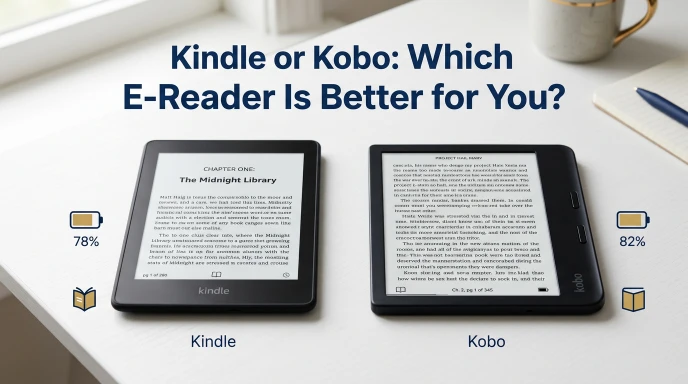
Kindle is better for Amazon’s ecosystem, while Kobo is better for flexibility and wider eBook format support.
Choosing between Kindle or Kobo can be hard if you are buying your first e reader. Both brands offer devices made for comfortable reading, long battery life, and easy access to digital books. Yet they are not the same.
People search for Kindle or Kobo because they want to know which e reader is better, which has more books, which is easier to use, and which one fits their reading habits. The answer depends on what you value most.
Kindle is Amazon’s e reader brand and has a strong connection with the Kindle Store, Kindle apps, and services such as Kindle Unlimited. Amazon launched the first Kindle in November 2007.
Kobo is another major e reading brand. Kobo began as an e reading service in 2009 and launched its first dedicated Kobo eReader in 2010.
So, Kindle or Kobo is not a spelling question. It is a comparison between two e reader brands. The best choice depends on your preferred store, file support, reading features, library access, and ecosystem.
Quick Answer
If you want a simple answer, Kindle is often the better choice for readers who already use Amazon, while Kobo is an excellent choice for readers who want more flexibility with supported book formats and library reading.
Both brands make dedicated e readers with E Ink screens, which are designed to provide a paper like reading experience.
| Feature | Kindle | Kobo |
| Brand | Amazon | Rakuten Kobo |
| Main ecosystem | Amazon Kindle Store | Kobo Store |
| E readers | Yes | Yes |
| E book apps | Yes | Yes |
| EPUB support | Available through supported workflows | Strong native support |
| Library borrowing | Depends on country and service | Strong library support in supported markets |
| Best for | Amazon users | Flexible readers |
| Reading experience | Excellent | Excellent |
Amazon introduced Kindle in 2007 as a dedicated wireless reading device. Kobo followed with its own dedicated e reader in 2010.
For example, someone who buys most books from Amazon may prefer Kindle. A reader who values EPUB support and library borrowing may prefer Kobo.
The Origin of Kindle or Kobo
The two names come from different companies and have different histories.
The history of Kindle
Amazon introduced the first Kindle on November 19, 2007. The original device allowed users to download books wirelessly without needing a computer. Amazon launched it with access to more than 90,000 books.
The Kindle name later became closely linked with digital reading. Amazon expanded the Kindle family with new hardware, Kindle apps, Kindle Direct Publishing, and other reading services.
The history of Kobo
Kobo has a different history. The company began as an e reading service in December 2009 after rebranding from Shortcovers.
In 2010, Kobo introduced its dedicated eReader. Its early approach focused on affordable reading and support for open standards such as EPUB and PDF.
Kobo later became part of Rakuten and expanded its e reading services across many countries.
Why are Kindle and Kobo different?
There is no British versus American spelling difference between Kindle and Kobo. They are brand names.
This is important because the keyword “Kindle or Kobo” may look like a typical “X or Y” spelling comparison keyword. In reality, the search intent is usually a product comparison.
British English vs American English Spelling
Unlike words such as colour/color or centre/center, Kindle and Kobo do not have British and American spellings.
Both names stay the same in English speaking countries.
| Term | American English | British English | Difference |
| Kindle | Kindle | Kindle | None |
| Kobo | Kobo | Kobo | None |
| e reader | e reader | e reader | Usually the same |
| ebook | ebook | ebook | Both forms are used |
| eBook | eBook | eBook | Brand/style variation |
You should not write “Kindel” or “Koboh” as alternative spellings. Those are simply incorrect forms of the brand names.
The main difference is therefore not spelling. It is the reading ecosystem and product features.
Which Spelling Should You Use?
If you are writing about these products, use the official brand names:
- Kindle
- Kobo
- Kindle e reader
- Kobo eReader
- Kindle or Kobo
Keep the exact keyword “Kindle or Kobo” when it fits naturally into your title, headings, introduction, and content.
For US readers
Use Kindle and Kobo exactly as written. You can also use terms such as:
- e reader
- ebook
- digital reader
- reading device
For UK and Commonwealth readers
The brand names remain Kindle and Kobo.
You may see differences in general English, but those differences do not change either brand name.
For global readers
Use the official names and explain product differences instead of treating them as spelling variations.
Common Mistakes with Kindle or Kobo
People often make mistakes when writing about these brands.
1. Treating them as spelling variants
Incorrect:
Kindle and Kobo are two spellings of the same word.
Correct:
Kindle and Kobo are two different e reader brands.
2. Writing “Kindel”
Incorrect:
I bought a Kindel last year.
Correct:
I bought a Kindle last year.
3. Writing “Kobo” as a generic e reader name
Kobo is a brand. Not every e reader is a Kobo.
Correct:
I use a Kobo e reader.
4. Assuming Kindle and Kobo use the same ecosystem
They do not. Each brand has its own services and store.
5. Comparing only the device price
A cheaper device may not be cheaper for you over time. Consider book prices, subscriptions, library access, accessories, and the books you already own.
Kindle or Kobo in Everyday Examples
Here are natural ways to use Kindle or Kobo in everyday writing.
In an email
I’m thinking about buying a new e reader. Do you recommend Kindle or Kobo?
In a news article
Readers have more choices today, with Kindle and Kobo competing in the e reader market.
On social media
Kindle or Kobo? Which one do you prefer for reading at night?
In a product review
This review compares Kindle or Kobo devices based on price, features, screen quality, and reading services.
In formal writing
The choice between Kindle or Kobo depends on the reader’s preferred digital bookstore and reading habits.
In a casual conversation
Should I get a Kindle or Kobo?
The phrase “Kindle or Kobo” works naturally as a comparison phrase because people use it when choosing between the two brands.
Kindle or Kobo:Google Trends & Usage Data
Google Trends can help show how people search for terms such as Kindle, Kobo, and Kindle or Kobo. However, Google Trends reports relative search interest, not exact sales or the total number of searches. Google also notes that Trends can compare search terms across time and regions.
This distinction matters.
A high Google Trends score does not automatically mean that a product sells more units. It only shows stronger search interest during the selected period and location.
Interest can also vary by country. Kindle has a strong connection with Amazon, while Kobo has developed a broad international presence. Kobo has historically promoted its open platform approach and has operated across many countries.
Search context also matters:
| Search | Likely User Intent |
| Kindle | Looking for Kindle products or information |
| Kobo | Looking for Kobo products or information |
| Kindle or Kobo | Comparing two brands |
| Kindle vs Kobo | Product comparison |
| Best Kindle | Choosing a Kindle model |
| Best Kobo | Choosing a Kobo model |
| Kindle Kobo EPUB | Checking file compatibility |
| Kindle Kobo library | Checking library options |
For a writer, this means “Kindle or Kobo” should be treated mainly as a comparison keyword rather than a spelling keyword.
Kindle vs Kobo: Key Differences
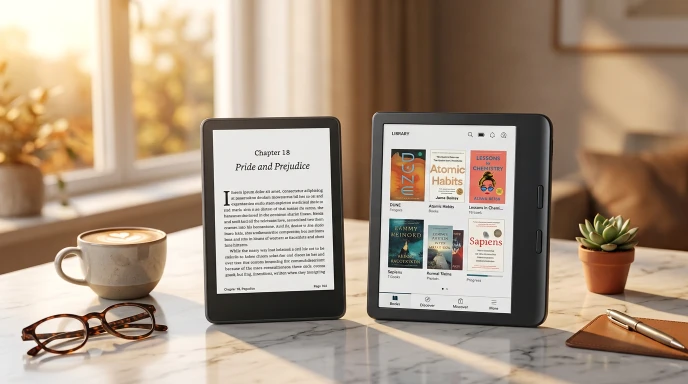
The biggest differences are not about basic reading quality. Both are designed for people who want a dedicated reading device.
1. Content ecosystem
Kindle is closely tied to Amazon’s ecosystem.
Kobo is tied to the Kobo bookstore and Rakuten’s e reading ecosystem.
If you already have a large collection of books from one platform, that can strongly influence your decision.
2. File support
Kobo has long emphasized open standards such as EPUB and PDF.
Kindle also supports several formats, but its ecosystem is more closely connected to Amazon’s own book services.
3. Library reading
Kobo has promoted integration with local library borrowing in supported markets. Its early e readers highlighted support for EPUB and PDF, including library borrowing.
However, library availability varies by country and library system.
4. Buying books
Kindle makes sense if you already buy books through Amazon.
Kobo makes sense if you prefer buying through Kobo’s bookstore or want an ecosystem with a strong focus on open formats.
5. Reading experience
Both can provide a comfortable reading experience without the distractions of a normal smartphone.
The exact experience depends on the model you choose.
Kindle or Kobo: Which One Is Better?
There is no single winner for everyone.
Choose Kindle if:
- You already use Amazon often.
- You want close integration with Amazon’s reading ecosystem.
- You use Kindle books or Kindle services.
- You want a simple Amazon based reading setup.
Choose Kobo if:
- You value EPUB support.
- You want more flexibility with open formats.
- Library borrowing is important to you and supported in your region.
- You prefer the Kobo ecosystem.
The most important question is not simply, “Which brand is better?”
Instead, ask:
Which ecosystem fits the way I already read?
That question usually leads to a better buying decision.
FAQ’s
Q1. Is Kindle better than Kobo?
Not for everyone. Kindle is a strong choice for Amazon users, while Kobo can be better for readers who value EPUB support and flexibility.
Q2. Is Kobo better than Kindle?
Kobo can be better for readers who prefer open formats and library features in supported regions. Kindle may be better for people who already use Amazon’s ecosystem.
Q3. Can I read Kindle books on Kobo?
Compatibility depends on the book, format, and digital rights restrictions. Kindle books purchased through Amazon may use formats or protections that prevent direct transfer to another e reader.
Q4. Can I read Kobo books on Kindle?
Not every Kobo book can be moved directly to a Kindle. Digital rights management and file format can affect compatibility.
Q5. Which is cheaper, Kindle or Kobo?
Prices vary by model, country, retailer, and sales period. Compare the complete cost rather than looking only at the device price.
Q6. Is Kobo an Amazon product?
No. Kindle belongs to Amazon, while Kobo is part of the Rakuten Kobo ecosystem.
Q7. Should I buy Kindle or Kobo?
Choose Kindle if Amazon’s ecosystem suits you best. Choose Kobo if EPUB support, flexibility, or library access is more important to you.
Conclusion
The Kindle or Kobo question is really about choosing between two major e reading ecosystems. It is not a question about British and American spelling. Kindle and Kobo are separate brand names, and both offer dedicated e readers for people who want a focused digital reading experience.
Amazon launched the first Kindle in 2007, while Kobo introduced its first dedicated eReader in 2010. Both brands have grown well beyond their early devices and now offer broader digital reading ecosystems.
For Amazon users, Kindle can be the easier choice. It fits naturally with Amazon’s bookstore and reading services. Kobo may be the better option for readers who value EPUB support, open standards, and library borrowing where available. Kobo has promoted these features since its early e reader products.
Before buying, think about where you buy books, which formats you use, and if library access matters. Also check the exact model, because features can differ between devices.
In short, Kindle is not automatically better than Kobo, and Kobo is not automatically better than Kindle. The right choice is the one that matches your reading habits, content library, and preferred ecosystem.
Discover More About!
- HND or NRT: Which Tokyo Airport Is Better for You?
- Kobe or Lebro: Who Was the Better Basketball Player?
- Papyrus or Undertale: What Is the Difference?

Hi, I’m Jordan Wells, a writer interested in English grammar, spelling, and word usage.
At Grammerynex, I simplify confusing words, grammar rules, and common English mistakes into clear, easy-to-understand explanations.
My goal is simple: make English easier, one word at a time.