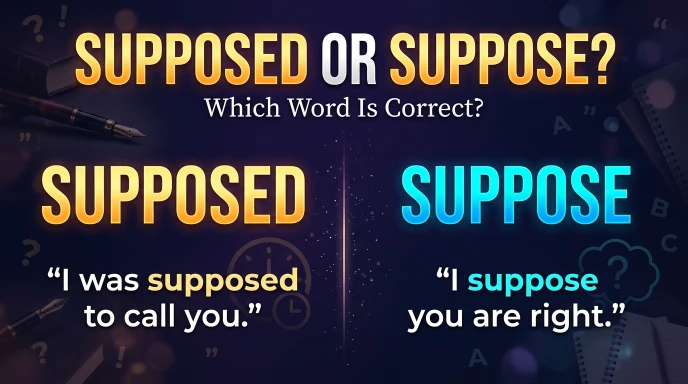
Have you ever wondered whether to write “supposed” or “suppose”? These two words look almost the same, but they have different meanings and uses. Many people mix them up in emails, schoolwork, social media posts, and daily conversations. The good news is that the difference is easy to learn.
“Suppose” is a verb. It means to think, guess, or imagine something. For example, “I suppose he is busy.”
“Supposed” is the past form and past participle of “suppose.” It also appears in phrases such as “supposed to,” which means expected or required to do something. For example, “You are supposed to arrive early.”
People search for this keyword because they want to choose the right form and avoid grammar mistakes. This guide explains both words in simple terms. You will learn their meanings, origins, correct use, and common errors. By the end, you will know when to use “supposed” and when to use “suppose.”
Quick Answer
“Suppose” is the base form of the verb, while “supposed” is its past form and past participle. Both words are correct, but you must use them in the right place.
Use suppose when you mean think, guess, or imagine.
- I suppose she is at home.
- Suppose we leave early.
- What do you suppose will happen?
Use supposed when you talk about a past thought or something that someone expects or should do.
- I supposed he knew the answer.
- You are supposed to finish your work.
- She was supposed to call me.
Remember this simple rule: use “suppose” for the base verb and “supposed” for past actions or expected duties.
The Origin of Supposed or Suppose
The words suppose and supposed share the same origin. They come from the Latin word supponere. This word means to put under, assume, or take something as a basis.
The word entered English through Old French. Over time, English speakers used “suppose” to mean think, believe, or imagine something.
Later, English formed the past tense and past participle by adding d. This gave us “supposed.”
Both words still share the same basic idea of assumption or belief. However, their grammar now gives them different roles.
Here is a simple example:
- I suppose he is right. (present thought)
- I supposed he was right. (past thought)
- He is supposed to be right. (expected or believed)
The spelling difference does not come from British or American English. It comes from the verb form and the way English grammar works.
British English vs American English Spelling
There is no spelling difference between supposed and suppose in British and American English. Both regions use the same forms.
The difference comes from grammar, not location. English speakers in the United States, the United Kingdom, Canada, and Australia use these words in the same way.
| Word | British English | American English | Meaning |
| Suppose | Suppose | Suppose | Think, guess, or imagine |
| Supposed | Supposed | Supposed | Past form or past participle |
| Supposed to | Supposed to | Supposed to | Expected or required |
Examples in both forms of English:
- I suppose this is the right way.
- You are supposed to wait here.
- We supposed the shop was open.
All three sentences work in British and American English.
Do not add or remove letters based on your location. Choose the form that fits your sentence.
Which Spelling Should You Use?
Your choice depends on the meaning of your sentence, not the country where you live.
For American English
Use “suppose” for a thought, guess, or idea. Use “supposed” for past actions and expectations.
- I suppose he will join us.
- You are supposed to wear a uniform.
For British English
Follow the same grammar rules. Both words keep the same spelling and meaning.
- I suppose it might rain.
- We were supposed to meet at noon.
For Global English
If you write for people around the world, use the standard forms. Keep “suppose” as the base verb and “supposed” for the past form or expected action.
The key is to check the sentence before you choose a word. Do not treat “supposed” and “suppose” as two spelling options for the same meaning.
Common Mistakes with Supposed or Suppose
Many writers make small mistakes with these words. These errors often happen when they forget the verb form or leave out a word.
Here are common mistakes and their corrections.
1. Using “suppose” instead of “supposed to”
Incorrect: You are suppose to study.
Correct: You are supposed to study.
Use “supposed to” when you talk about a duty or expectation.
2. Using “supposed” instead of “suppose”
Incorrect: I supposed you are right. (when you mean a present belief)
Correct: I suppose you are right.
Use “suppose” for a present thought.
3. Forgetting the final d
Incorrect: She was suppose to call.
Correct: She was supposed to call.
The phrase “was supposed to” needs the word “supposed.”
4. Adding an extra d
Incorrect: I suppossed he was there.
Correct: I supposed he was there.
The correct spelling is “supposed,” with one “s” after the first “o” and a final “d.”
5. Confusing “supposed to” with “suppose to”
Incorrect: They are suppose to arrive soon.
Correct: They are supposed to arrive soon.
Remember that “supposed to” is the correct phrase for an expected action.
Supposed or Suppose in Everyday Examples
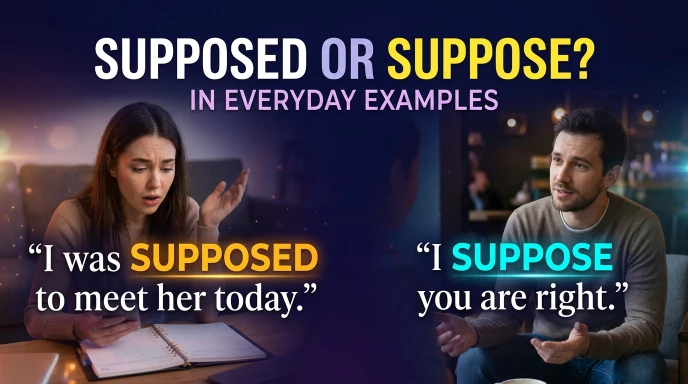
You can use both words in daily speech and writing. The examples below show how they work in different settings.
1. In Emails
Use “suppose” when you share an idea or belief.
- I suppose we can move the meeting to Friday.
- I suppose this plan will work.
Use “supposed” when you explain an expected action.
- You are supposed to send the report today.
- I was supposed to reply yesterday.
2. In News
Writers may use “supposed” when they report an expected or claimed fact.
- The team was supposed to announce its decision today.
- The event was supposed to begin at 10 a.m.
3. On Social Media
People often use “suppose” to share thoughts.
- I suppose everyone needs a break.
- Suppose you could travel anywhere. Where would you go?
They also use “supposed to” to discuss plans.
- We were supposed to meet today!
- This was supposed to be easy.
4. In Formal Writing
Use the correct form to make your meaning clear.
- We suppose that the results will remain stable.
- The committee was supposed to review the report.
- The new rule is supposed to improve safety.
These examples show that both words have a place in clear and correct writing.
Supposed or Suppose:Google Trends & Usage Data
People search for “supposed or suppose” because the words look alike and often appear in similar sentences. The phrase “supposed to” also appears often in everyday English, which can make the difference harder to understand.
However, the two words serve different grammar roles:
- Suppose: A base verb that means think, guess, or imagine.
- Supposed: A past form or past participle that also appears in “supposed to.”
Search interest can change by country, season, and user needs. Students may search for the difference while studying grammar. Writers may look for help when editing emails, essays, or other content.
Google Trends can help compare search interest in different regions and over time. However, this article does not include verified live search figures or country rankings. Search interest also does not prove that one word is more grammatically correct than the other.
Both forms are correct. Your sentence decides which one you need.
Supposed vs Suppose: Quick Comparison Table
| Feature | Suppose | Supposed |
| Word type | Verb | Past form and past participle |
| Main use | Think, guess, or imagine | Past thought or expectation |
| Example | I suppose he is busy. | I supposed he was busy. |
| Common phrase | Suppose that… | Supposed to |
| Correct in US English | Yes | Yes |
| Correct in UK English | Yes | Yes |
The main difference is simple: “suppose” expresses a thought, while “supposed” often shows a past thought or an expectation.
FAQs
Q1. Is “supposed” or “suppose” correct?
Both words are correct. Use “suppose” as the base verb and “supposed” for the past form or expected action.
Q2. Is it “suppose to” or “supposed to”?
“Supposed to” is correct when you talk about something expected or required. For example, “I am supposed to work today.”
Q3. What does “suppose” mean?
“Suppose” means to think, guess, or imagine something. For example, “I suppose he is right.”
Q4. What does “supposed” mean?
“Supposed” is the past form and past participle of “suppose.” It also means expected or believed in phrases such as “supposed to.”
Q5. Is “supposed” past tense?
Yes. “Supposed” is the simple past and past participle form of “suppose.” For example, “I supposed she knew.”
Q6. Do British and American speakers spell these words differently?
No. British and American English use the same spellings: “suppose” and “supposed.”
Q7. How can I remember the difference?
Remember that is the base verb. Add “d” to form “supposed.” Use “supposed to” when you describe an expected action.
Conclusion
The difference between supposed or suppose is simple once you understand their grammar. Both words are correct, but they do not have the same use.
Use “suppose” when you want to share a thought, guess, or idea. For example, “I suppose he is busy.” Use “supposed” when you talk about a past thought or an expected action. For example, “I supposed he was busy” or “I am supposed to call him.”
Remember that “supposed to” always includes the final. This small detail can help you avoid one of the most common grammar mistakes.
British and American English follow the same spelling rules for both words. You do not need to change the spelling for a different audience. Just focus on the meaning and grammar of your sentence.
With a little practice, you can use “suppose” and “supposed” with confidence. Check the sentence, choose the right form, and keep your writing clear and correct.
Read More About!
Suit or Tux: Which One Should You Wear?
Signors or Signers: Which Spelling Is Correct?
Either or Shoes: Which Is Correct?

Hi, I’m Jordan Wells, a writer interested in English grammar, spelling, and word usage.
At Grammerynex, I simplify confusing words, grammar rules, and common English mistakes into clear, easy-to-understand explanations.
My goal is simple: make English easier, one word at a time.







2 thoughts on “Supposed or Suppose: Which Word Is Correct?”