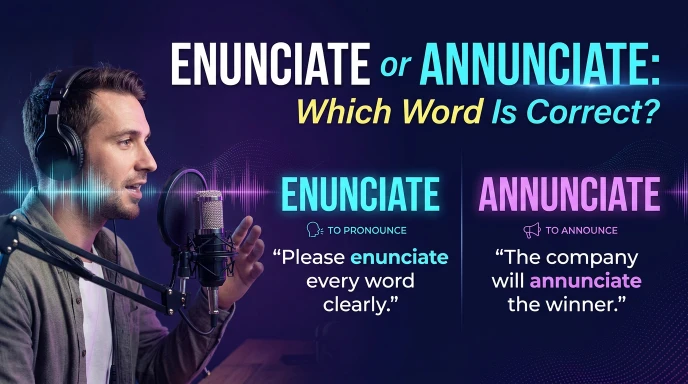
Enunciate is the standard word when you mean to speak clearly and pronounce words carefully. Annunciate is a rare word and does not serve as a common substitute.
Enunciate is the correct and common word when you mean to speak clearly and pronounce each word with care. Many people search for enunciate or annunciate because the two words look and sound alike. However, they do not have the same level of use. “Enunciate” appears in daily speech, writing, and speech lessons. “Annunciate” is a rare word that most people do not need in normal writing.
Think about a teacher who asks a student to speak more clearly. The teacher may say, “Please enunciate your words.” This means the student should make each sound easy to hear. You may also see this word in public speaking tips, acting lessons, and language guides.
This guide explains the meaning of both words in simple terms. You will learn how to use them, where they come from, and how to avoid common mistakes. You will also see clear examples for daily use. By the end, you will know why “enunciate” is the best choice in almost every common situation.
Quick Answer
Enunciate is the standard word for speaking clearly and saying each word with care. Annunciate is rare and does not work as a common replacement.
Use enunciate when you want someone to speak more clearly.
- Please enunciate your words.
- The speaker enunciates each word with care.
- Good actors learn to enunciate on stage.
The rare word annunciate has appeared with the sense of announcing or proclaiming something. Most readers will find “announce” or “proclaim” clearer and more natural.
| Word | Main meaning | Common use |
| Enunciate | Speak clearly and pronounce words well | Common |
| Annunciate | Announce or proclaim | Rare |
Quick tip: Choose “enunciate” when you talk about clear speech. Choose “announce” when you mean to tell people about news or an event.
The Origin of Enunciate or Annunciate
The words enunciate and annunciate have Latin roots. Their histories help explain why they look alike.
“Enunciate” comes from the Latin word enuntiare. It means to declare, report, or state clearly. English later used the word for clear speech and careful pronunciation.
“Annunciate” comes from a related Latin form linked to annuntiare, which means to announce or report. This word has a much rarer place in modern English.
The words share a link to the idea of telling or saying something. Yet their modern use differs.
Here is a simple way to understand them:
- Enunciate: Say words clearly.
- Annunciate: Announce or proclaim; a rare use.
- Announce: Tell people about something.
For most modern writing, “enunciate” and “announce” cover the meanings you need. You do not need to use “annunciate” in everyday speech.
British English vs American English Spelling
British and American English use the same spelling for enunciate and annunciate. Neither region uses a different spelling for these words.
The main difference does not come from location. It comes from meaning and common use.
| Word | British English | American English | Use |
| Enunciate | Enunciate | Enunciate | Speak clearly |
| Annunciate | Annunciate | Annunciate | Rare word for announce or proclaim |
| Enunciation | Enunciation | Enunciation | Clear speech or pronunciation |
| Annunciation | Annunciation | Annunciation | Formal term, often used in a religious context |
Examples in British and American English:
- Please enunciate so everyone can hear you.
- The news host speaks with clear enunciation.
- The actor needs to enunciate every line.
These sentences work in both forms of English. You do not need to change the spelling for a US or UK audience.
Which Spelling Should You Use?
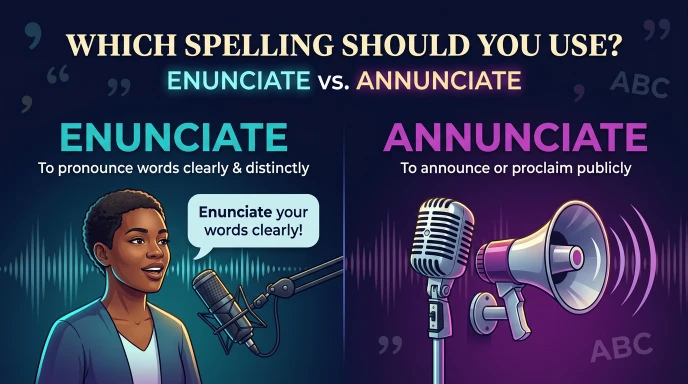
Your choice depends on what you want to say. It does not depend on your country.
For American English
Use “enunciate” when you talk about clear speech.
- Please enunciate during your speech.
- She enunciates every word.
Use “announce” when you mean to share news.
- They will announce the winner today.
For British English
Follow the same rule. “Enunciate” is the normal word for clear speech.
- He needs to enunciate more clearly.
- The teacher asked the class to speak with care.
For Global English
Choose words that most readers know. “Enunciate” works for clear speech, while “announce” works for news or public statements.
Avoid “annunciate” unless you have a clear reason to use this rare word. Simple word choices make your writing easier to read.
Common Mistakes with Enunciate or Annunciate
Writers often mix up these words because they look alike. Here are common mistakes and easy ways to fix them.
1. Using “annunciate” for clear speech
Incorrect: Please annunciate your words.
Correct: Please enunciate your words.
Use “enunciate” when you want someone to speak clearly.
2. Using “enunciate” when you mean announce
Incorrect: The school will enunciate the results tomorrow.
Correct: The school will announce the results tomorrow.
Use “announce” when you share news or information.
3. Confusing enunciate with pronunciation
Incorrect: You need to improve your enunciate.
Correct: You need to improve your enunciation.
“Enunciate” is a verb. “Enunciation” is the noun.
4. Forgetting the meaning of enunciate
Incorrect: He enunciated the news to the public.
Better: He announced the news to the public.
Use “enunciate” for clear speech, not as a normal replacement for “announce.”
5. Using a rare word when a common word works
Unclear: The leader will annunciate the new plan.
Clear: The leader will announce the new plan.
Choose simple and familiar words when you write for a wide audience.
Enunciate or Annunciate in Everyday Examples
You may see “enunciate” in speech lessons, school tasks, work meetings, and public speaking tips. The examples below show how to use the words in daily life.
In Emails
Use “enunciate” when you discuss clear speech.
- Please enunciate during the online meeting.
- Your speech sounds clear when you enunciate each word.
For a news update, use “announce.”
- We will announce the new schedule by email.
In News
News reports may use “enunciate” when they discuss a speaker’s voice.
- The news host must enunciate each name clearly.
- The speaker took time to enunciate the key points.
Use “announce” when a person or group shares news.
- The company will announce its plans next week.
On Social Media
You may see “enunciate” in posts about speaking skills.
- Speak slowly and enunciate each word.
- Good public speakers know how to enunciate.
For a public update, use “announce.”
- We are happy to announce our new project!
In Formal Writing
“Enunciate” fits essays, reports, and speech guides.
- Speakers should enunciate words with care.
- Clear enunciation helps an audience follow a speech.
- The student learned to enunciate difficult terms.
These examples show why “enunciate” is the best choice for clear speech.
Enunciate or Annunciate:Google Trends & Usage Data
People search for “enunciate or annunciate” because both words look similar. They may also hear them in speech or see them in older texts. This can make it hard to know which word to choose.
In modern English, “enunciate” has a clear and common role. People use it in public speaking, acting, teaching, language learning, and speech advice. “Annunciate” appears far less often. Most people use “announce” or “proclaim” instead.
Search interest can vary by country and context. Students may search for the difference while learning vocabulary. Writers may look up the words when they edit a sentence. Speakers may search for “enunciate” when they want to improve their speech.
Google Trends can help compare search interest over time and across regions. However, this article does not include verified live search figures or country rankings. Search interest also does not decide whether a word is correct.
The safest choice is simple: use “enunciate” for clear speech and “announce” for sharing news.
Enunciate vs Annunciate: Quick Comparison Table
| Feature | Enunciate | Annunciate |
| Word type | Verb | Verb |
| Main meaning | Speak clearly | Announce or proclaim |
| Modern use | Common | Rare |
| Speech lessons | Yes | No, not normally |
| Formal writing | Yes | Rare |
| British spelling | Enunciate | Annunciate |
| American spelling | Enunciate | Annunciate |
| Best everyday choice | Yes | Usually no |
The key difference is use. “Enunciate” means to speak clearly. “Annunciate” is a rare word linked to announcing something.
FAQs
Q1. Is enunciate or annunciate correct?
“Enunciate” is the common and standard choice when you mean to speak clearly. “Annunciate” is a rare word with a meaning linked to announcing or proclaiming.
Q2. What does enunciate mean?
“Enunciate” means to say words clearly and pronounce each sound with care. For example, “Please enunciate during your speech.”
Q3. Is annunciate a real word?
Yes. “Annunciate” is a rare English word. It has a sense linked to announcing or proclaiming, but most people use “announce” instead.
Q4. What is the difference between enunciate and announce?
“Enunciate” means to speak clearly. “Announce” means to tell people about news, plans, or events.
Q5. Is enunciate the same in British and American English?
Yes. Both British and American English use the same spelling and meaning.
Q6. What is the noun form of enunciate?
The noun form is “enunciation.” It means the act or way of speaking words clearly.
Q7. How can I use enunciate in a sentence?
You can say, “Please enunciate your words so everyone can understand you.” This sentence asks someone to speak clearly.
Conclusion
The difference between enunciate or annunciate is easy to learn. “Enunciate” is the common word for speaking clearly and saying each word with care. You can use it in speech lessons, schoolwork, meetings, acting, and formal writing.
“Annunciate” is a real but rare word. It has a link to announcing or proclaiming something. However, most readers know and use the word “announce” for that meaning. So, you should not use “annunciate” as a normal replacement for “enunciate.”
Remember this simple rule: enunciate means speak clearly, while announce means share news. British and American English follow the same spelling rules for these words. You do not need a different form for either audience.
When you write, think about the message you want to share. If you talk about clear speech, choose “enunciate.” If you talk about news or an event, choose “announce.” These simple choices will make your writing clear, natural, and easy to understand.
Discover More About!
Supposed or Suppose: Which Word Is Correct?
Suit or Tux: Which One Should You Wear?
Signors or Signers: Which Spelling Is Correct?

I’m Riley Morgan, a writer at Grammerynex, where I write about English grammar, spelling, word meanings, and everyday language usage. I’ve always enjoyed exploring how words work and why some English terms can be confusing. My goal is to explain grammar and word differences in a simple, clear, and practical way so readers can understand English better and use it with confidence.








2 thoughts on “Enunciate or Annunciate: Which Word Is Correct?”